


- WEBSITE -





Current location: Home > BLOGS > Industry Information >
Glazed Tile Roll Forming Machine: How Antique Roof Tiles Are Made
Time:2026-10-19 09:53:16 Author:xiangyi Click:67
Glazed Tile Roll Forming Machine: How Antique Roof Tiles Are Made
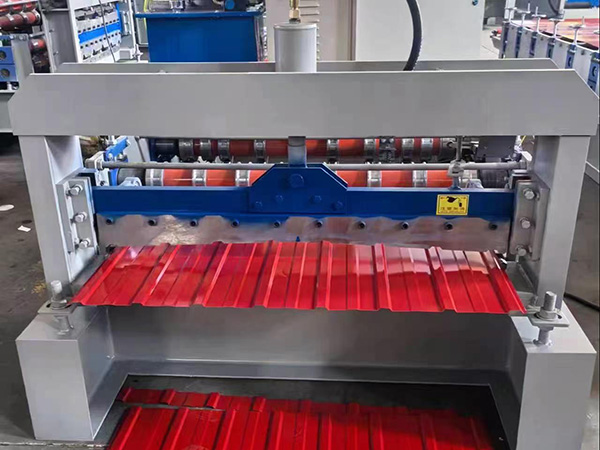
Glazed tiles carry a look that imitates traditional clay roofing, but on a modern production line they are formed from coated steel at speed. A glazed tile roll forming machine is the equipment that makes that possible, pressing the curved, overlapping tile shape into metal strip without cracking the paint or losing the fine surface detail.
The machine is more demanding than a simple corrugated line, because the profile has deeper relief and more decorative detail. This article explains how the shape is produced and what to look for when specifying one.
The Profile and Its Purpose
A glazed steel tile imitates the rounded, often barrel-like form of traditional ceramic roofing. The profile includes a raised decorative crown, a flat or subtly textured field, and overlap features that let adjacent sheets interlock and shed water.
Because the look is the product, surface quality is not a secondary concern. Any scratch, rub mark or coating crack is immediately visible on a finished roof, so the forming process has to be gentler than a line making plain industrial sheet.
Forming an Antique Tile Step by Step
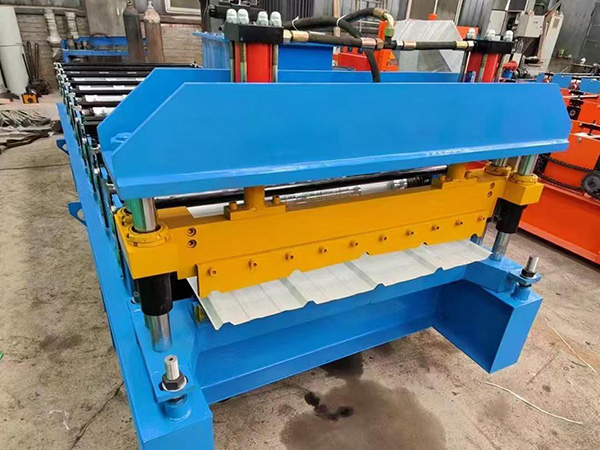
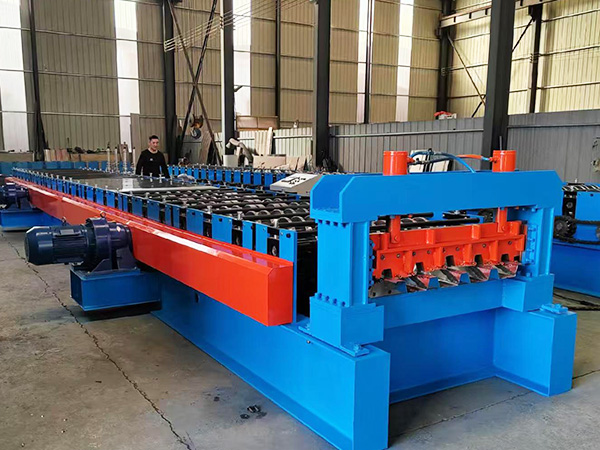
Coated coil is unwound on a decoiler and fed into the forming section. The stations are arranged so that the decorative relief is built up gradually. Early stations work the flat area between the ribs, later stations raise the crown and shape the overlap edges.
Spacing between roll stations is chosen to avoid stretching the strip between two bends at once, which is the usual cause of coating cracks and wavy edges. A well-designed flower pattern, as the sequence of progressive pass shapes is called, keeps each pass within the ductility of the coated material.
After forming, the sheet is cut to length and stacked. Longer runs of decorative tile often use a flying cut to keep the line moving.
Protecting the Coating During Forming
Coated steel is a three-part material: steel core, metallic coating and organic topcoat. The metallic coating resists corrosion; the topcoat provides colour and weather resistance. Forming must preserve both.
Two things protect the surface. First, roll finish: polished, hardened rolls reduce dragging and stop the abrasive marking that rough rolls cause. Second, roll pressure: over-tightened stations squeeze the coating at the bend radii and leave tracks along the panel. Setting roll gaps to the actual coil thickness, rather than tightening them as a habit, is one of the simplest quality controls a factory can adopt.
Specifications Worth Confirming
Material thickness for decorative tile usually sits between 0.3 mm and 0.8 mm. Coil width and the decoiler capacity need to match the sheet width the profile requires. Forming speed for glazed profiles is generally lower than for simple trapezoidal sheet, often around 6 to 15 m/min, because the deeper shape needs gentler deformation.
Number of stations, shaft diameter and drive power all rise with profile complexity. Ask the manufacturer to state the station count and the shaft size rather than only the output speed.
Cutting, Control and Finished Handling
The cutter should leave a clean edge that does not chip the coating. Hydraulic cutting is preferred on tile lines for its speed and repeatability. Length accuracy is set from the control panel, and a batch function lets the operator queue several order quantities in sequence.
Finished panels need careful handling. Stacking without interleaving, or sliding one panel across another, damages the decorative surface faster than anything that happens inside the machine. Run-out tables with rollers and trained stacking practice protect the product after it leaves the line.
Matching the Machine to the Market
Glazed tile machines sell into markets where traditional roofing aesthetics meet modern budgets: residential estates, heritage-style commercial buildings, and tourist or cultural projects. The factory that can offer both a plain corrugated profile and a decorative glazed profile covers more of that demand from one workshop.
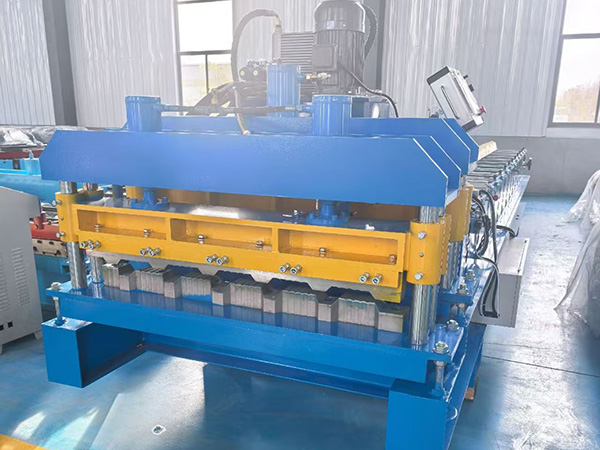
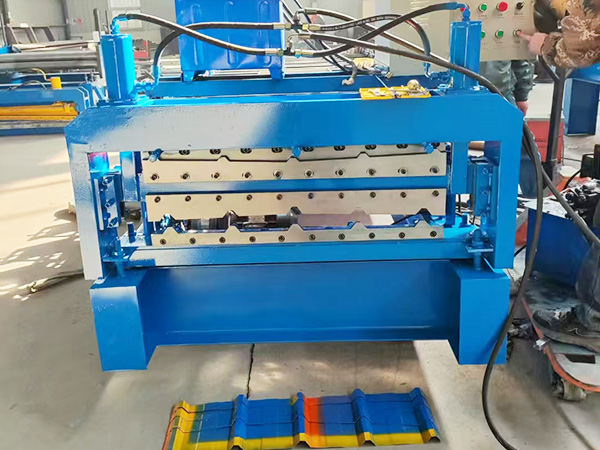
That is why many buyers choose a double-layer machine that carries a glazed tile layer and a simple tile layer on a single frame. It keeps the capital cost down while widening the order book.
What to Look for in a Supplier
Ask for sample panels formed on the exact machine, ideally in the colour and thickness you intend to run. Ask how the roll design handles the specific profile you need, and whether the flower pattern has been proven on similar work before.
A factory that treats the glazed tile line as a surface-quality problem, not just a shaping problem, is the one that will deliver panels worth putting on a roof. That is the standard to apply when comparing quotations, because the cheapest machine is rarely the cheapest roof.
References
Roll Forming Handbook, edited by George T. Halmos, CRC Press, 2005.
ASM Handbook, Volume 14B: Metalworking: Sheet Forming, ASM International, 2006.
EN 10169:2010+A1:2012, Continuously organic coated (coil coated) steel flat products, Technical delivery conditions.
ISO 3575:2016, Continuous hot-dip zinc-coated carbon steel sheet of commercial and drawing qualities.
D. Bhattacharyya, P. D. Smith, C. H. Yee and I. F. Collins, "The prediction of deformation length in cold roll forming," Journal of Mechanical Working Technology, Vol. 9, Issue 2, 1984.
S. M. Panton, S. D. Zhu and J. L. Duncan, "Geometric constraints on the forming path in roll forming channel sections," Proceedings of the Institution of Mechanical Engineers, Part B, Vol. 206, 1992.
Mechanics of Sheet Metal Forming, Z. Marciniak, J. L. Duncan and J. Hu, Butterworth-Heinemann, 2002.

CONTACTS
TEL:+8615830824095
URL:www.qiluomachinery.com
ADD:Botou City, Cangzhou City, Hebei Province