


- WEBSITE -





Current location: Home > BLOGS > Technical Documentation >
Roll Forming Auxiliary Equipment and Optional Accessories
Time:2026-09-27 07:22:38 Author:xiangyi Click:85
Roll Forming Auxiliary Equipment and Optional Accessories
A roll forming machine is rarely sold alone. The main roll former is the center of a line, but the decoiler, leveler, punch, cutoff, and stacker decide how much labor the line needs and how good the finished product is. Choosing the right auxiliary equipment is as important as choosing the rolls. This guide walks through the common options so buyers can configure a line that fits the product and the budget without paying for features they will never use.
Decoiler and Coil Car
The decoiler is mandatory; without it there is no strip feed. A manual expandable decoiler suits low volume, while a hydraulic decoiler with a coil car handles heavy coils and faster changeover. The coil car lifts the coil from the ground and pushes it onto the mandrel, removing the need for a crane at every change and protecting operators from crush risk during loading.
Leveling and Pre-Cutting
Optional Stations to Consider
Leveling unit: Flattens coil memory before the first roll. Recommended for thin or pre-painted strip where flatness shows in the finished panel and where wave at entry becomes twist at exit.
Pre-cut shear: Cuts the strip to length before forming when holes are not required. Simpler and cheaper than a flying cutoff for fixed-length products with no piercing.
Punch press: Adds holes, slots, and notches while the strip is flat, far faster than drilling finished parts. Hydraulic or servo, sized to the hole pattern and the line speed.
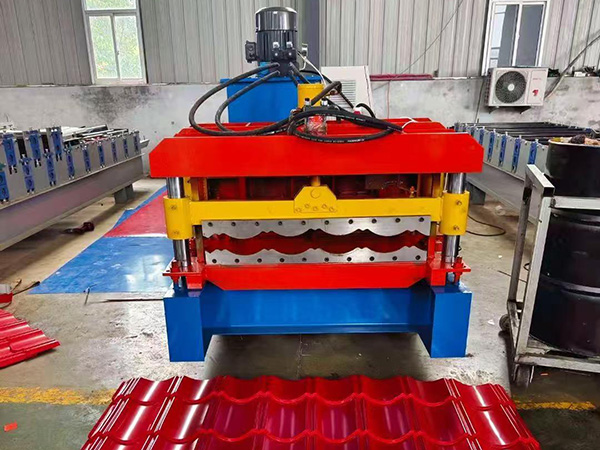
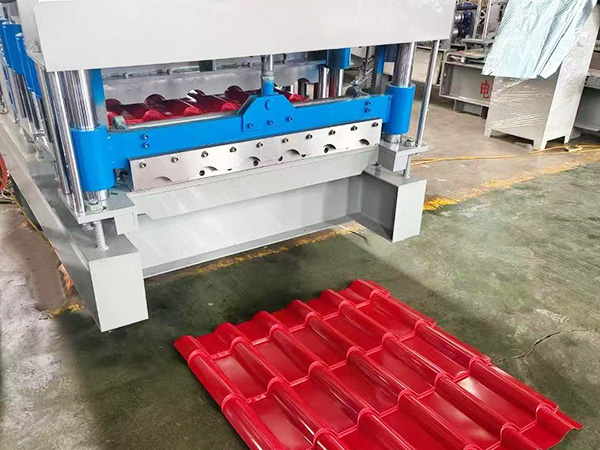
Embossing or step unit: For glazed tile profiles, a press forms the decorative step before or between roll stations to create the classic tile look.
Cutoff and Stacking
The flying cutoff shears the moving profile to length without stopping the line, which is why most production lines choose it. A stationary shear is cheaper but stops the strip for each cut, lowering output and risking length error. Downstream, a run-out table with a stacker or an automatic bundler reduces manual handling and keeps panels scratch-free.
Conveyor and Packaging Options
For long products, a roller conveyor carries the cut piece away from the shear to a stacking point without the operator walking the length of the shop. An automatic stacker turns the pieces and counts them into neat bundles, and a wrapper or strapping unit finishes the pack. These options pay back quickly on high-volume lines where handling dominates labor cost.
Controls and Safety Options
A basic panel runs the line; a PLC with touch screen adds recipe storage for each profile, speeding changeover. Safety options include light curtains at the entry, emergency pull cords, and guarded pinch points. These are not luxuries on a high-speed line; they are expected by any serious buyer and by most workplace inspectors who visit the floor.
Matching Options to Your Product
List what the product needs: holes, fixed or variable length, coating protection, and output target. Then add only the options that serve those needs. A supplier who understands your scope will propose a lean configuration rather than loading the quote with accessories you will not use, and will explain why each option earns its place. Buying every option "just in case" ties up capital in features that sit idle and complicates training for the team that must run the line every day.
Keep spare critical parts; blades, seals, and a sensor; in stock so an option failure does not stop the whole line. The best auxiliary equipment is the kind that runs unnoticed for years, and that comes from choosing proven options and maintaining them on schedule with the same discipline as the main former.
Spare Parts Strategy
Every optional station has wear items; punch dies, shear blades, seals; that eventually need replacement. Ask the supplier for a consumable list with part numbers and typical life, then stock the few that cause stoppages. A line configured perfectly but starved of one blade is still a stopped line, so the accessory plan must include the parts plan from the start of the project.
References
Roll Forming Line Configuration Engineering Guide
Coil Handling and Decoiler Selection Manual
Metal Forming Press and Cutoff Standards
Machine Safety and Guarding Requirements
Automation Options for Continuous Forming Lines

CONTACTS
TEL:+8615830824095
URL:www.qiluomachinery.com
ADD:Botou City, Cangzhou City, Hebei Province