


- WEBSITE -





Current location: Home > BLOGS > Technical Documentation >
How a Roll Forming Machine Works: Step-by-Step Working Principle
Time:2026-09-21 06:48:21 Author:xiangyi Click:123
How a Roll Forming Machine Works: Step-by-Step Working Principle
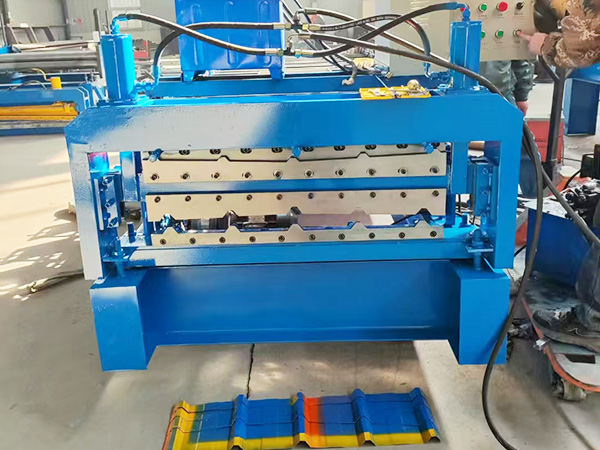
A roll forming machine turns a flat steel strip into a precise, continuous profile by bending it gradually through a series of rotating rolls. Unlike stamping, which forms a shape in one hit, roll forming reshapes the metal a little at each station, so the line can run continuously at high speed with very little scrap. Understanding the working principle helps buyers choose the right configuration and helps operators diagnose problems on the floor before they become scrap.
From Coil to Strip: The Feeding Stage
Production starts at the hydraulic decoiler, which holds the steel coil and feeds strip at a tension controlled by the line. A peeler and a leveling unit then flatten the natural coil curvature so the strip enters the first roll station flat and centered. If this stage is wrong, every downstream station inherits the error, which is why alignment here matters so much more than operators expect.
The Roll Stations: Where Bending Happens
The Forming Sequence in Practice
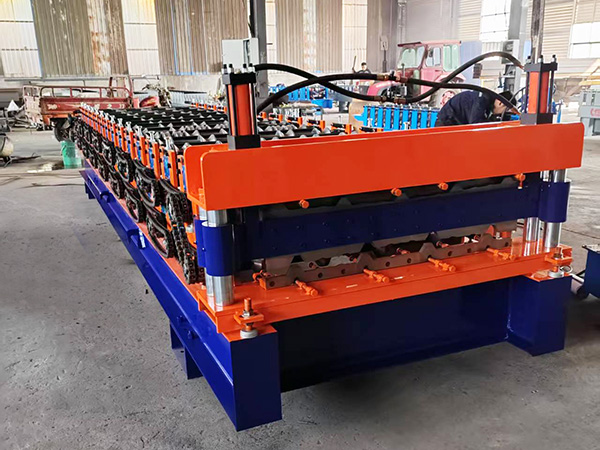
Station 1 to 3: The edges begin to turn up. Only a few degrees of bend per station, so the metal flows rather than cracks. Each top and bottom roll pair is machined to the profile at that exact step.
Middle stations: The section develops its full shape. Flanges, lips, and webs form progressively. The number of stations depends on material thickness and profile depth; a deep purlin needs more gradual steps than a shallow panel.
Final stations: The profile is sized and calibrated. These rolls remove springback and lock the final dimensions. Slight over-bend here compensates for the metal trying to return to flat after the load is released.
Why Gradual Bending Matters
If too much bend happens at one station, the outer fiber of the steel stretches and the inner fiber compresses until the surface cracks or the strip wrinkles. Spreading the deformation across many roll stations keeps the strain within the material's limit. This is the core principle that lets a roll forming machine make long, consistent parts that a press brake cannot match economically at volume.

Punching, Notching, and Cutoff
Many lines add a punch press before the rolls to make holes and notches while the strip is still flat, which is faster and cleaner than drilling finished parts. At the exit, a flying cutoff shears the moving profile to length without stopping the line. For some products a pre-cut shear feeds fixed lengths into the rolls instead, trading a little speed for a simpler, cheaper configuration.
Material Flow and Tension Control
The decoiler brake sets the tension that keeps the strip taut between stations. Too much tension stretches the section; too little lets it wander and buckle. On modern lines a loop controller adjusts decoiler speed to match the roll former, holding a steady strip reservoir that absorbs speed changes during punch and cutoff. This quiet coordination is what makes high-speed production stable.
Common Misunderstandings
A frequent mistake is to treat roll forming like bending, assuming one setting forms any thickness. In reality each coil thickness and grade needs its own roll pressure and station alignment. Another misunderstanding is that more stations are always better; they help deep profiles but add cost and length for simple ones. A supplier who explains these trade-offs is teaching the principle, not just selling steel.
Output and Stacking
The formed profile leaves the last station at line speed and is received by a run-out table or an automatic stacker that bundles the pieces. Because the process is continuous, a single operator can oversee several lines, which is why roll forming is the most cost-effective method for long-run metal sections and why it dominates building and storage products.
When the working principle is respected; correct station count, aligned entry, clean rolls, and steady tension; the machine delivers thousands of meters of identical profile with minimal intervention. That consistency is exactly what a roll forming supplier sells, and what the end customer depends on for every panel that leaves the yard.
References
ASM Handbook Volume 14B: Metalworking Sheet Forming
Roll Forming Technology and Equipment Design Manual
Continuous Bending Process Fundamentals
Metal Strip Feeding and Decoiling Engineering Guide
Roll Forming Line Commissioning Best Practices

CONTACTS
TEL:+8615830824095
URL:www.qiluomachinery.com
ADD:Botou City, Cangzhou City, Hebei Province